 Trade mark from an early catalogue | The Beginning:Joseph Hampton was a maker of lifting jacks, copying presses, ratchet drill braces, carpenters bench screws, flooring cramps, and pipe wrenches etc., at the Kings Hill Works, Wednesbury Staffordshire, in1868. 1) Joseph Hampton, The Younger, was applying for tool patents on behalf of The Company between 1894 and 1898.2) The Steel Nut Company was a manufacturer in Franchise Street, Kings Hill, Wednesbury in 1896. 3) In 1900, Kelly’s Staffordshire lists the The Steel Nut & Joseph Hampton Ltd. Woden Works Franchise Street, Wednesbury, Staffs. | |||||||||||||||||||||
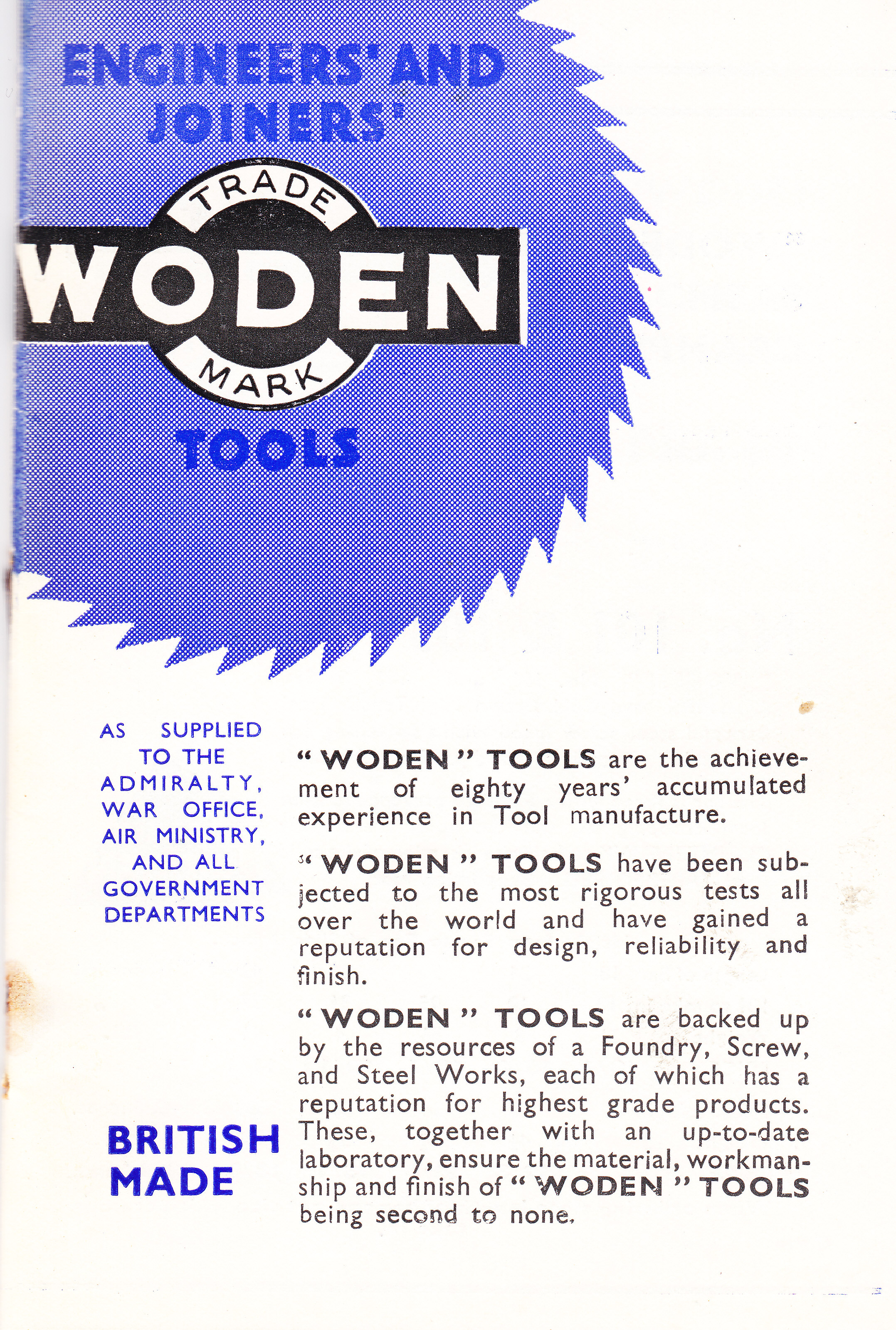
Early 20th Century:In 1914, Whitakers Red Book lists the Tool Department as a speciality of The Company, making vices, cramps and other Joiners and Engineerstools 4). The Company also had a Steel Department and Foundry, being well placed and equipped to manufacture all the parts required for the making of hand tools. The hand tool speciality of the Company was a relatively small operation within the overall product range of metal castings, nuts & bolts and related steel products There is now some excellent information about The Company on various established internet sites and for more details of the history of The Steel Nut & Joseph Hampton Ltd. (SNJH) and The Woden Factory, the reader may to refer to the pages of the following sites:- Local history of Wenesbury and The Steel Nut & Joseph Hampton Ltd |  Early advertising | |||||||||||||||||||||
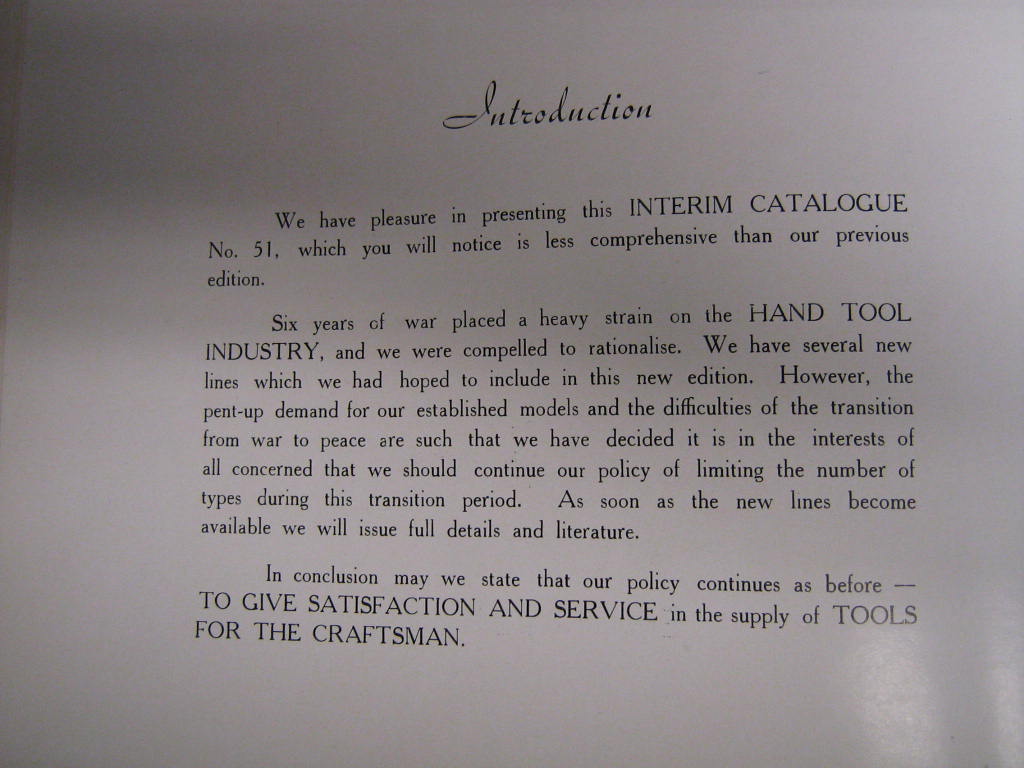
| 1930's 40's and 50's:With The Companys approval as an Air Ministry supplier;producing finished metal components to Admiralty specifications; iron and non-ferrous metal castings for the Marine Industry; it is likely that it was heavily involved in production for the war effort between 1939 and 1945. As in the First World War, this could have included munitions. It is likely that hand tool production was restricted to that required by essential users only and pre-war lines were not generally available to tool shops. After WWII, like other tool manufacturers, The Company struggled to return to normal production due to labour, fuel and material shortages, among other reasons, as noted in the introduction to the 1946 Interim Catalogue. Similar notes were promulgated by other tool manufacturers in the immediate post war period. In 1951, with the publication of catalogue 52, The Company announced improved production from its re-built Woden factory. Woden branded tools were available from tool shops, but The Company did not advertise direct to amateur woodworkers until 1953. Throughout 1953, an advertisement featured the No.189 pattern woodworking vice plus steel sash and T-bar cramps. A newly introducted line of metal handplanes was advertised from February 1954 and a wider variety of tools from 1955. 1956 saw the introduction of several new lines of joiners cramps and it was about this time that the widest range of tools was on offer. In addition to planes, there were several patterns of sash, veneer and G-cramps; six woodworkers vices; and about a dozen engineers or pipe vices . Towards the end of the 1950's. and early 60's., new tool patterns were aimed at the DIY market and some were made using die cast alloy. Despite selling some excellent and competitively priced tool lines, Woden Tools Ltd. was taken over by Record in early 1961. The parent company (Steel Nut & Joseph Hampton Ltd.), continued with its iron & steel core products business until 1965 when it was acquired by F H Tomkins (Holdings) Ltd. | |||||||||||||||||||||
Plane Making:Hand plane manufacture did not commence until late 1953 or early 1954 after the takeover of W.S Manufacturing of Birmingham around 1952 4) In the early 1950’s, the British tool
making industry continued to be re-generated following the 1939-45 war years.
The demand for hand Export
and educational supply contracts were particularly lucrative but, The takeover
of W.S provided The Company with the opportunity to In the rebuilt Woden factory, SNJH had all the resources – foundry, steel stock, machine shops, testing house etc., to expand and, for their contribution to the war effort, may have had Government assistance to do so. SNJH took time to tool
up for plane
manufacture and market products The first plane for sale, The Woden W78, was first
advertised in early Following the takeover of Woden Tools Ltd., plane assembly and |
| |||||||||||||||||||||
Trade Mark, 1957 | Woden Tools Ltd: Woden Tools Ltd. was set up in early 1957 6) to manage
the Record acquired
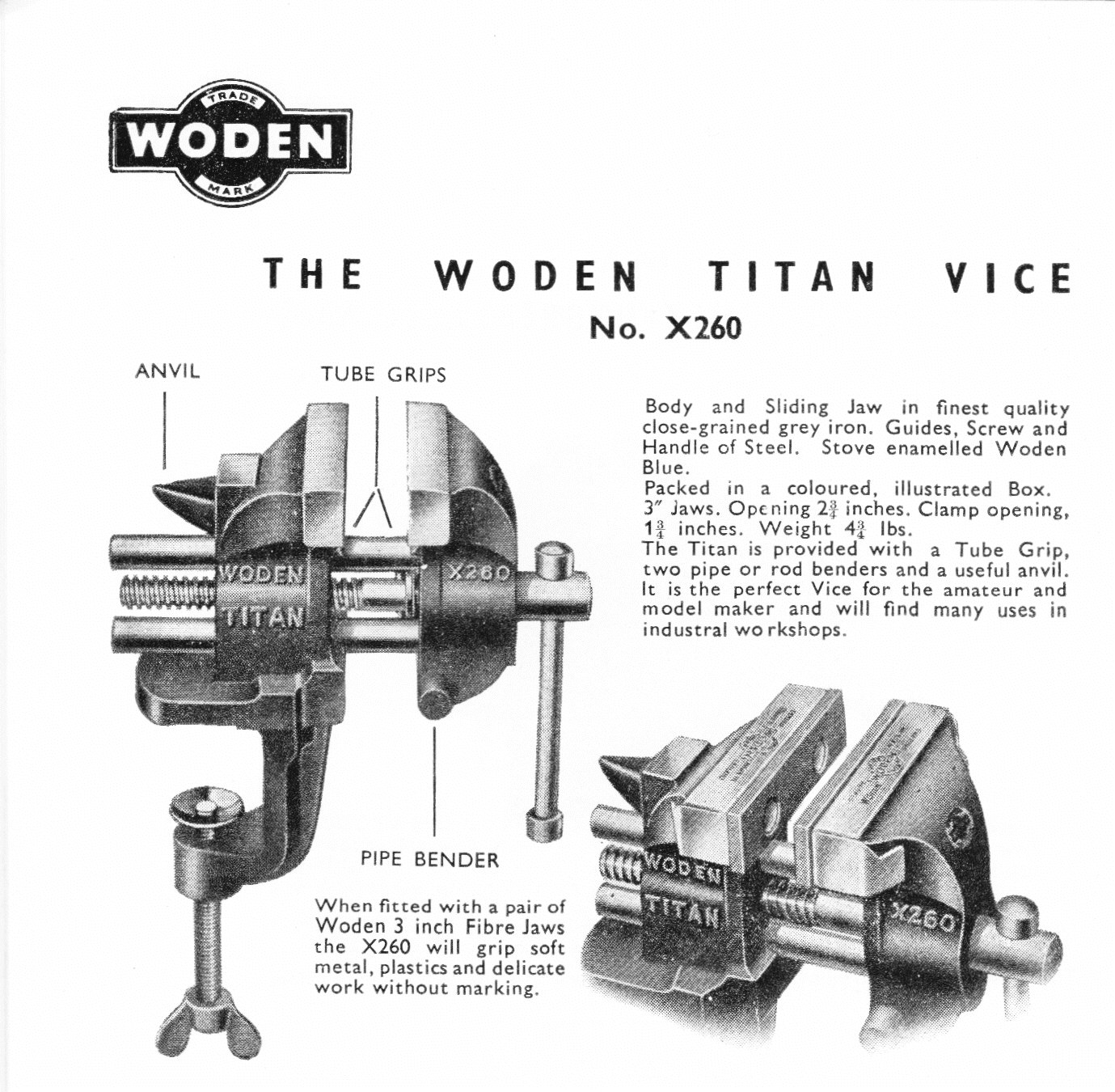
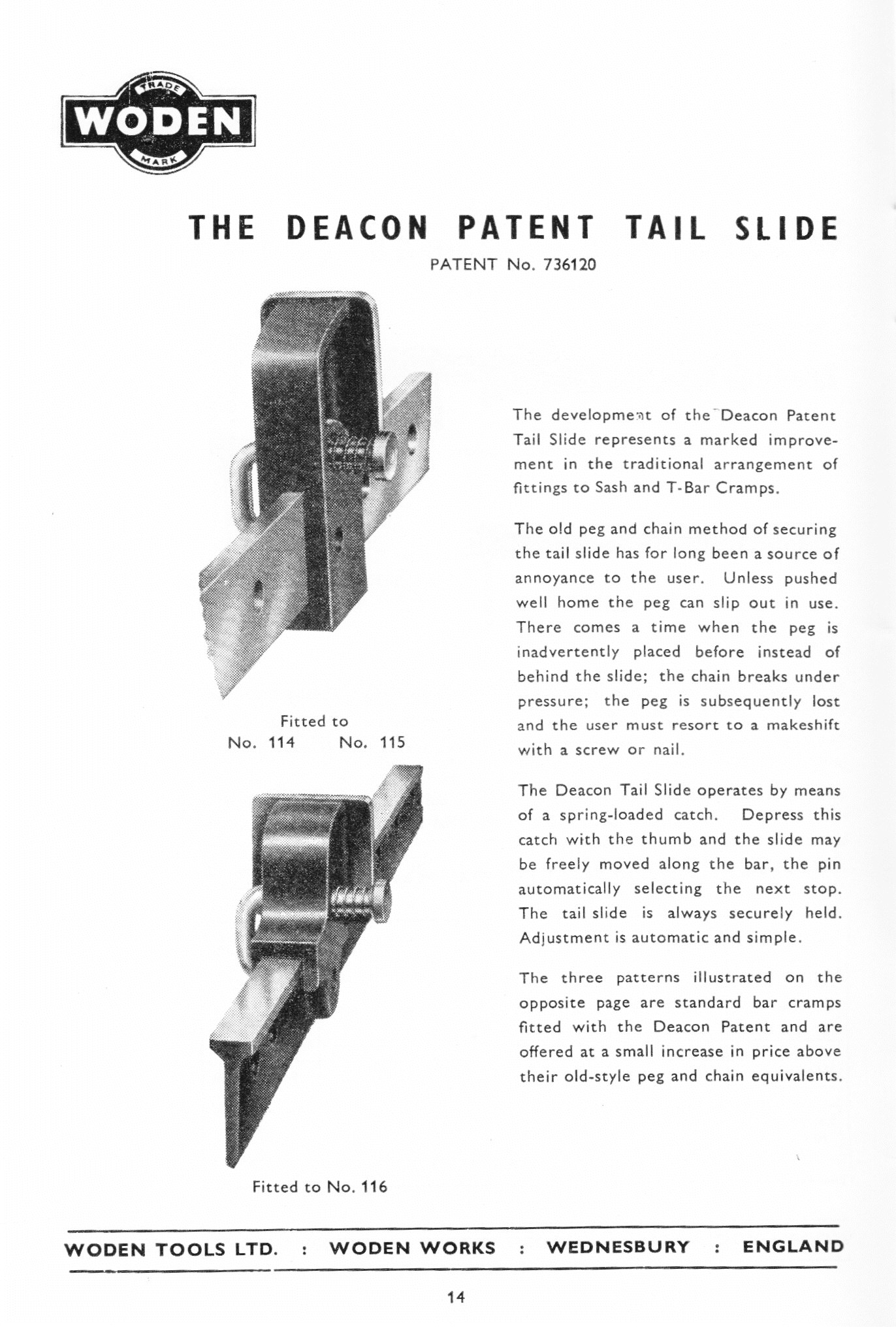
Woden Tools Ltd., (Woden) in early 1961.hand tool speciality of the company, but still traded from Wednesbury. Several new lines of tools were introduced around this time, notably the patented Deacon tail slide sash cramps and two patterns of corner cramp (see diary of events). Also, from examining many examples of Woden tools, including planes, it is evident that parts started to be sourced from external suppliers. Some tools from other manufacturers appeared in the catalogues, so Woden Tools Ltd. was also acting as a tool factor or distributor. Plane manufacture continued at Wednesbury until around April 1961, when Woden Tools Ltd., was taken over by C&J Hampton Ltd. (Record), of Sheffield. Other than for the purposes of removing competition, the circumstances of the takeover are not known at this time. Record were known to be particularly acquisitive during the 1960’s, and other lesser known tool brands were acquired in addition to Woden. A letter from Woden dated 11thApril 1961 informed The Trade that production of Woden tools was being switched to Sheffield. Gradually, all Woden parts were to Record specifications. The planes were sold in the U.K. and abroad until dis-continued around mid. 1965. Other Woden brand tools continue to be sold until the late 1960's., after which the brand was no longer available. Some former Woden tools were re-numbered and were sold under the Record brand. | |||||||||||||||||||||
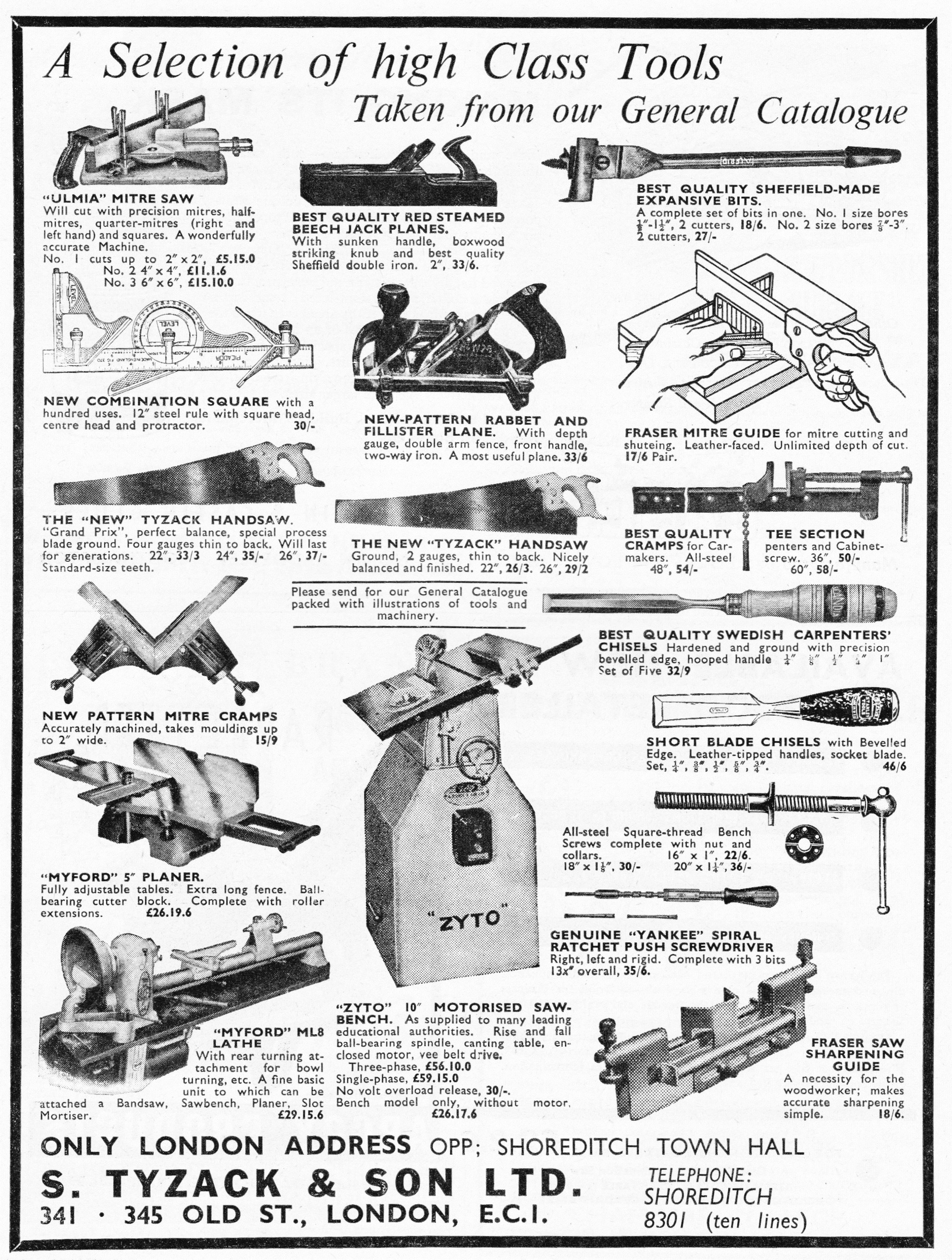
Diary of Events:Whilst the Woden hand plane is the main interest on this site, the manufacture of other excellent Woden hand tools cannot be ignored.With this in mind, the following diary of events has been compiled, relating to the manufacture and supply of hand tools throughout the history of Woden Tools, but concentrating on Post War production. The diary and the other notes which follow could not have been compiled without reference to the archives at The Hawley Collection in Sheffield. Thanks to Mr Ken Hawley M.B.E. and his volunteer Staff, for permitting access to these records and permitting some images to be copied. Other references are noted at the foot of this document. 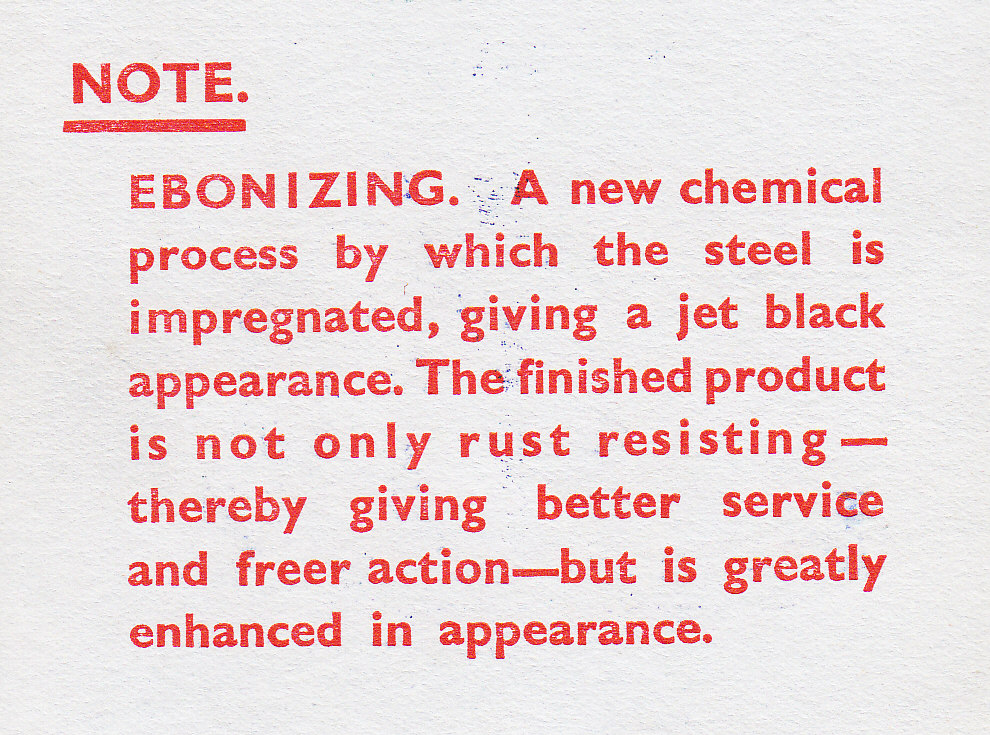 From 1938 catalogue 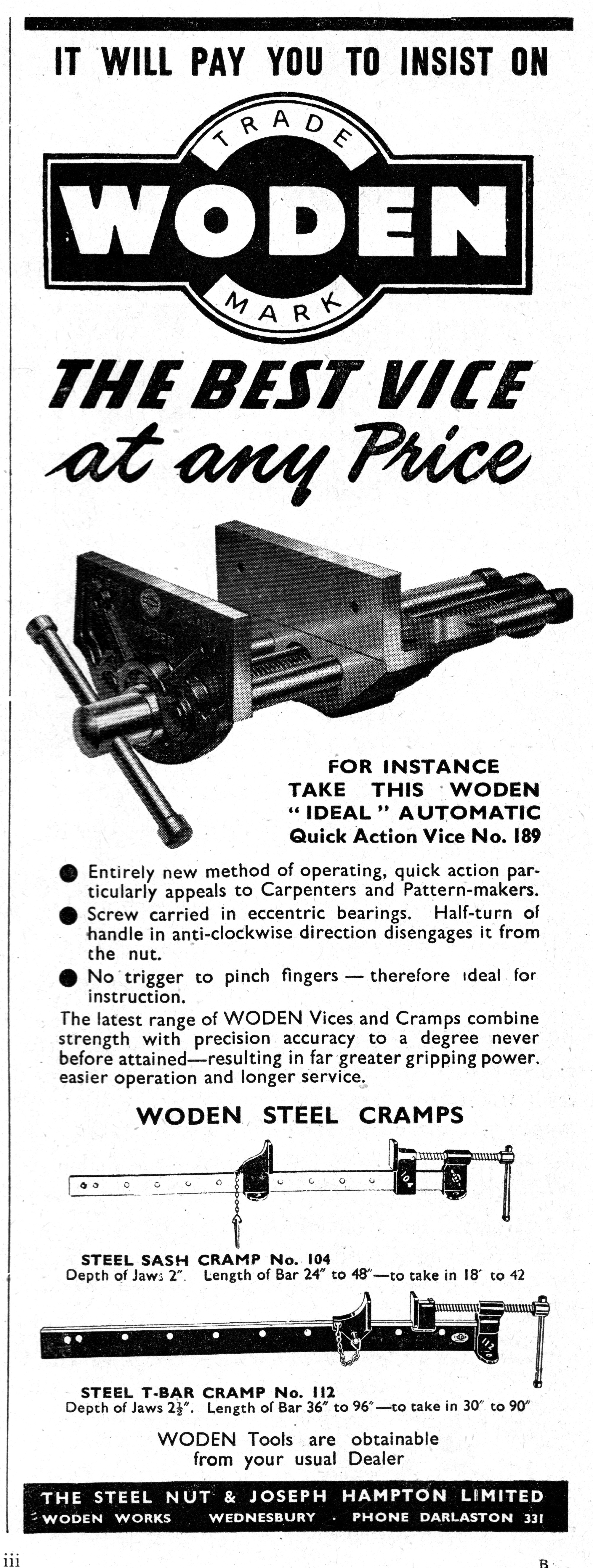 Woden tools 1953
. |
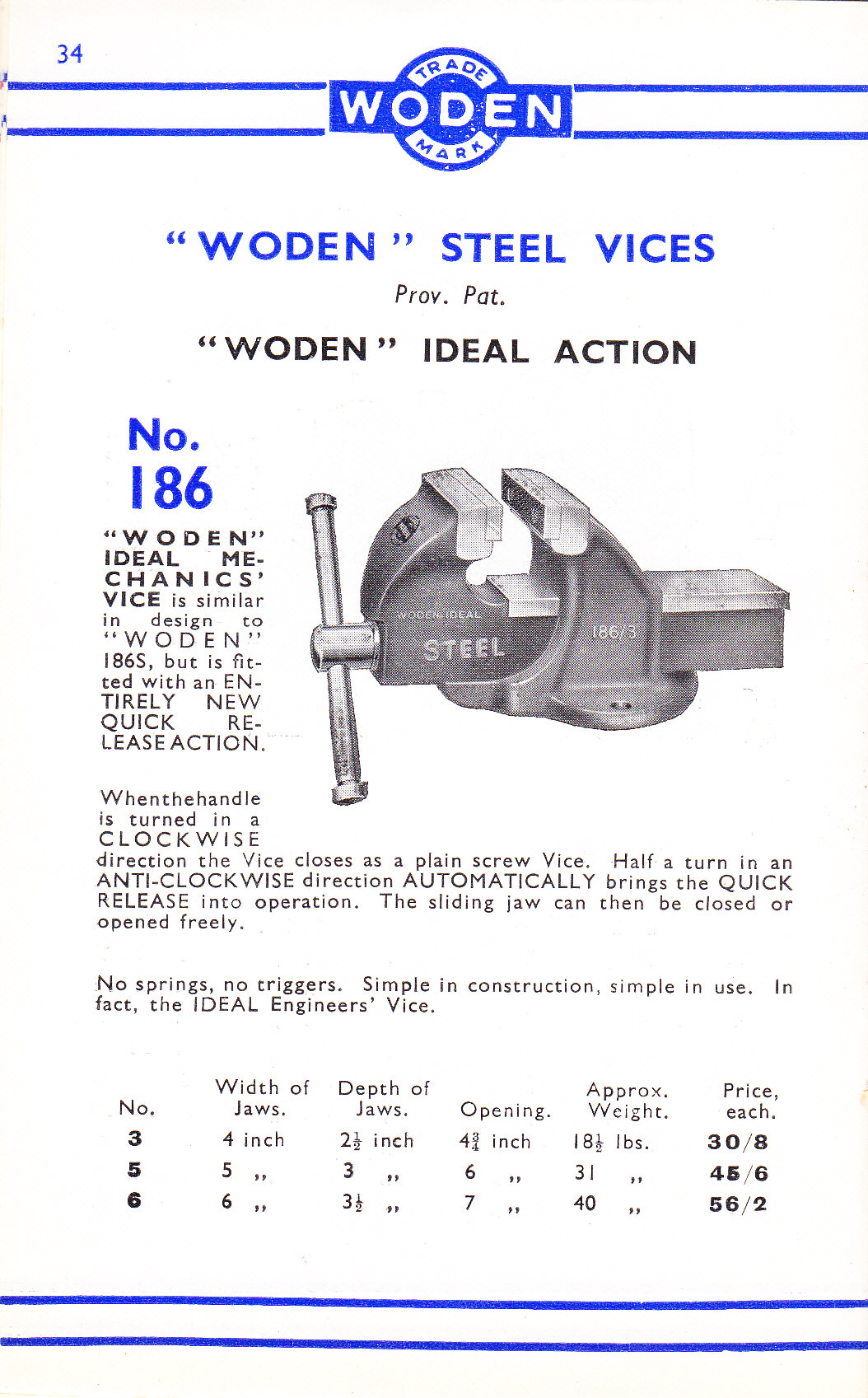
From 1938 catalogue 1898 Amalgamation with Joseph Hampton, Toolmaker, of Wednesbury, Staffs. 1914 Specialist Tool Division, making vices, cramps, Joiners and Engineers tools 4) 1920 and 1927 Illustrated catalogues of Engineers and Joiners Tools issued. 1937 GB and USA Patents granted for “Improvements relating to vices” Woden “Ideal Action” Engineers and Woodworkers vices in production; Stand at British Industries Fair, Birmingham 4). 1938 Ebonising introduced as a protective finished on steel parts. 1939 Supplier to The Admiralty, War Office, Air Ministry and Aviation Industry; . 1946 Hand tool manufacture resumes; 1951 Re-built Woden Factory in production; 1952 Acquires W.S. Manufacturing, Birmingham, maker of hand planes and other tools; 1953 GB Patent granted “Improvements in quick release vices” Woden Ideal Quick Action 1954 Introduces Woden rebate, bench and block planes; Booklet No. 52d issued. 1955 Booklet/Catalogue 52E issued; 1956 Catalogue No. 52E re-issued; No. 126 14 inch G-cramp available; “Tower Jack” and lever Catalogue No. 57 issued; X251 machine Floor cramps geared patterns 142B and 143B dis-continued; Commenced selling some lines of un-catalogued (factored) tools via representatives, 1958 Catalogue No. 58 issued; Further GB800885 patent granted “Improvements in or relating to vices” (for A120/A122); Introduces pushpin I (X170); No. 95 machine vice dis-continued. 1960 Catalogue No. 60 issued; X180 QUIKSAW introduced; Larger sized pushpin II (X171) introduced; Introduces Woden wallplugs in a range of sizes (Z106 to Z114); A120 and A122 woodworkers vices dis-continued and replaced with the A130 rapid action Woodworker’s vice incorporating the American Wilton patent, (GB819506); 1961 X190 dowelling Jig introduced; X172 Tack introduced; Woden Tools Ltd. Taken over Tools) of Sheffield 7); Catalogue No.60 re-issued. 1962 Catalogue Cat.30 issued. A130 rapid action woodworkers vice re-designated X130; and grooving attachment for power drills. 1967 Catalogue Cat.31 re-issued. 1968 Catalogues WF.1 (thrice) and W1 issued. 1969 (01 September) Last known reference to Woden Tools in price list HPL15 (Cats. 31 and W1). | |||||||||||||||||||||
|
| |||||||||||||||||||||
|
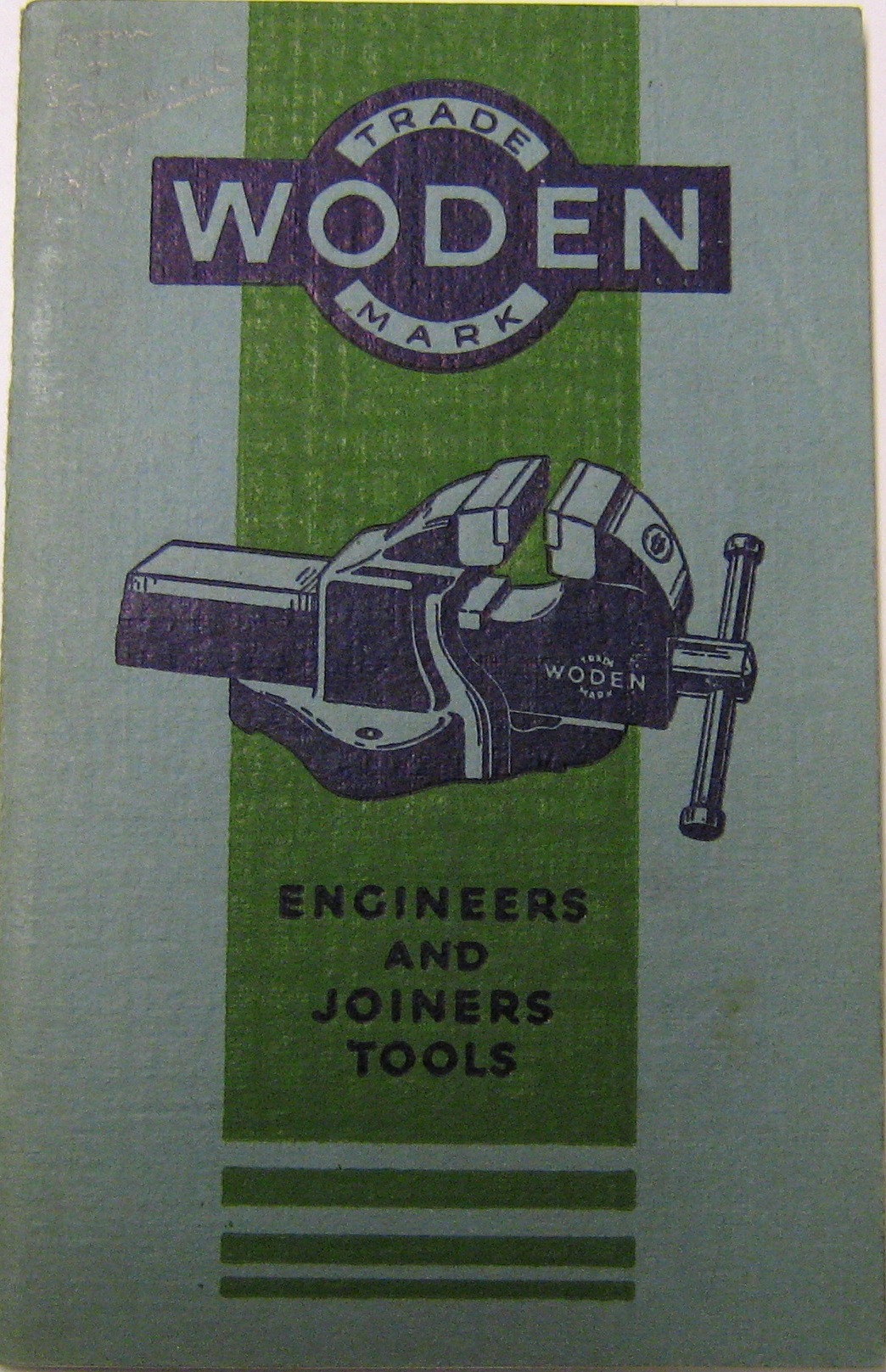
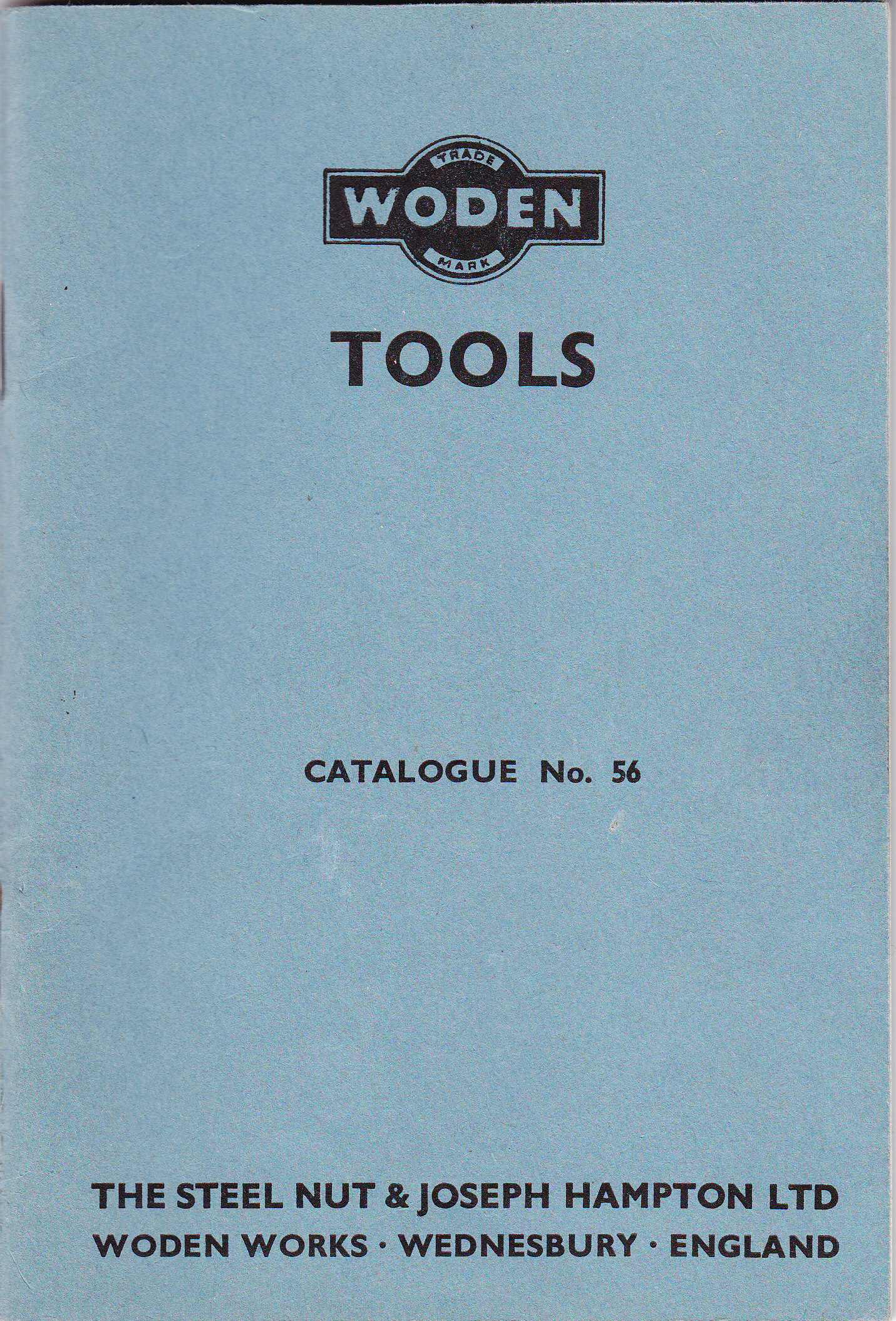
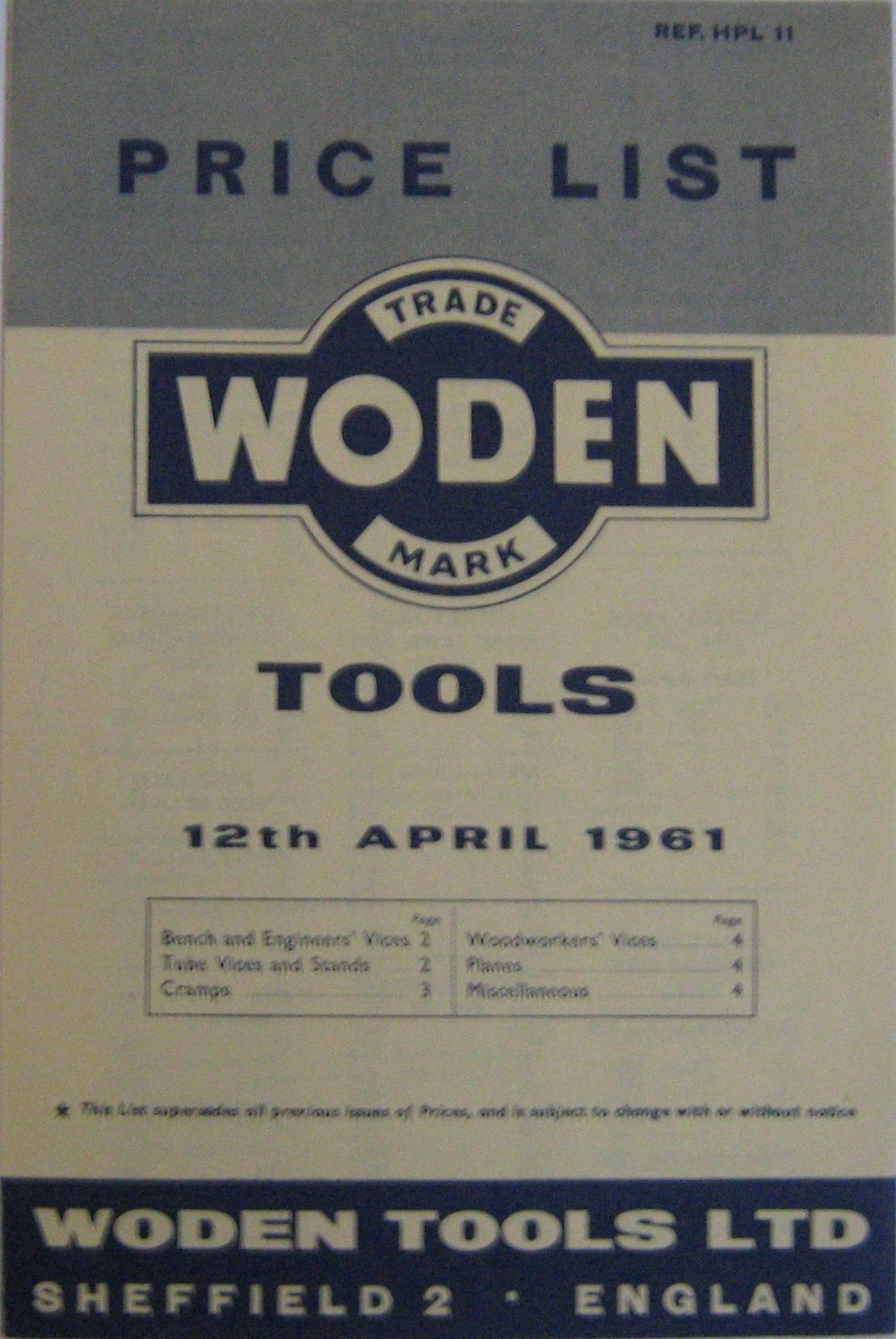
CATALOGUES AND PRICE LISTS:The earliest known Woden catalogue is in the HawleyCollection at Sheffield. 8) “Illustrated Catalogue of Engineers and Joiners Tools” 1920. The format of the catalogues varied over time from hard to soft backed. In addition, a number of small pictorial covered pocket catalogues (Abridged Lists), were issued for distribution by national tool dealers, for example Buck & Hickman Ltd. 1920 Illustrated Catalogue of Engineers and Joiners Tools, black hardback, 43 pages; 1922 Illustrated Catalogue of Engineers and Joiners Tools - available as a small booklet in landscape format with a buff cover, 43 pages. This is the earliest known soft cover catalogue. 1927 Illustrated Catalogue of Engineers and Joiners Tools, black hardback, 77 pages; 1938 (September) Abridged List No. 51, grey, green and blue soft cover, 48 pages; Later post war Woden Tools catalogues were hard-backed A5 sized books, either black or blue covered, with a price list contained in a pocket at the back,. 1946 Interim Catalogue No. 51, black, 77 pages; 1951 Catalogue No. 52, dark blue cover, 66 pages; After 1951, Engineers and Joiners tools were presented in small brown or light blue card backed booklets (catalogues) as follows:- 1951 Abridged Pocket List No. 51, grey, green and blue cover; 1952 Booklet 52c, about 8 x 5 inches, brown cover, 50 pages; 1954 Booklet 52d, same size as 52c, blue cover; 52 pages. (The first catalogue to include hand planes); Catalogue No. 56, blue cover, 60 pages; (The last original SNJH/Woden Tools catalogue), 60 pages. Note: SNJH catalogues were only dated by the year. Price lists have specific dates (see below). 1961 Catalogue No. 60, blue cover, 60 pages; SNJH catalogue used by Record (Woden) with red lettered new address label on the front, later replaced by Cat. 30; yellow and black cover, 59 pages; yellow and black cover, no hand planes listed, 47 pages; 1967 Catalogue Cat.31 (1967 Ed.) re-issued, 47 pages; From 1968, in common with Record, Woden catalogues and price lists were printed in a loose leaf A4 sized format . Catalogue WF.1, Woden and Fabrex (11/68), 4 pages. Catalogues from April 1961 were issued by Woden Tools Ltd., Sheffield. West Bromwich.  Revised brand mark and colours on 1968 catalogues |
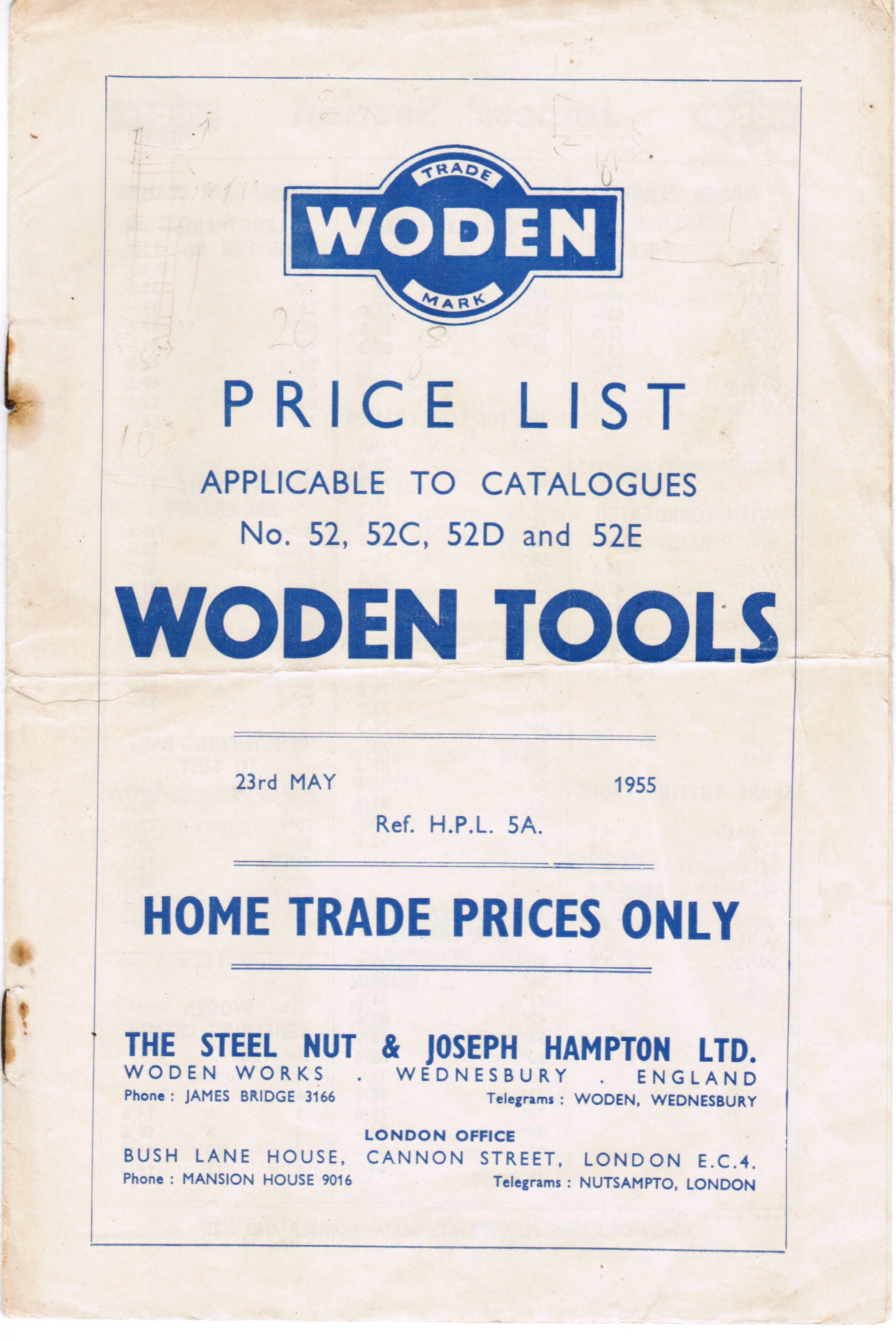
| Price lists were prefixed with “H” (Home Trade) or “E” (Export, Net) followed by a number in consecutive order. Spare Parts Lists (S.P.L.) being published from time to time. Price lists known to have been published viz. Date Price List Refers to catalogue number/(notes) 16th September 1948 E.T.L.3 29/1/1951 H.P.L.1 52 22/10/1951 H.P.L.2 (Revised) 52 23 May 1955 HPL4A 52,52C and 52D 23 May 1955 H.P.L. 5A 52, 52c, 52d and 52E (change of telephone number plus price revisions) 23rd April 1956 H.P.L. 6A 52, 52C, 52D and 52E S.P.L. 6A (probably the last SNJH price lists) 1st FEB 1957 HPL7 (probably the first Woden Tools Ltd. price list; included factored lines for the first time). 14th July 1957 H.P.L.8 (Plane price increases) 08 April 1959 HPL 9 30th June 1960 H.P.L.10 and E.P.L.10 12th April 1961 HPL11 All previous catalogues 1st May 1961 EPL11 2nd March 1964 HPL12 9th March 1964 EPL12 18th April 1966 HPL13 2nd May 1966 EPL13 1st March 1968 HPL14 and EPL14 November 1968 WF1/PL68 WF.1 1st September 1969 HPL15 Cat. 31 and W1 Nb. Booklet and Catalogue have the same meaning. Price lists from 12th April 1961 were issued by Woden Tools Ltd., Sheffield. Other Record export documents/price lists in The Hawley Collection: 1962 EPL (Italian) (Lists full range of Woden planes) 02/1963 EPL (German) (Lists full range of Woden planes) 05/1967 EPL (German) (Only lists X260 Titan Vice; X251 Drill Vice; M130/1/2/3 Engineers Vices; X180 Quicksaw and 2300 Corrucut). 1968 EPL (Italian) (Only lists M130/1/2/3 Vices). 1968 EPL (Portuguese) (Lists NO Woden tools). 1968 EPL (Finnish) (Lists NO Woden tools). 1968 (cat. 3/68) W1 (Dutch) Same as W1 above 01/09/1969 Record Export List XNP12 (Lists NO Woden tools). |
|
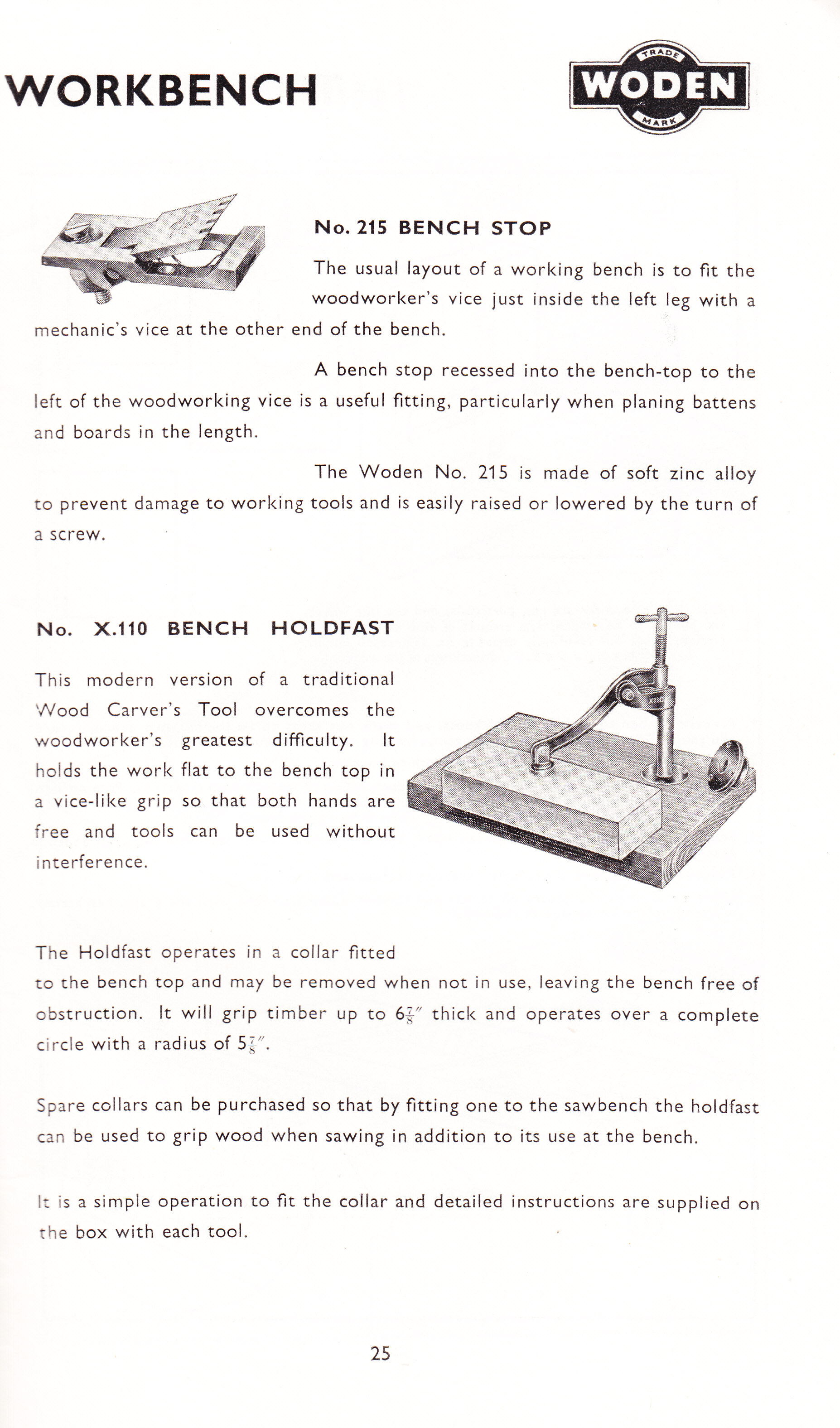 | 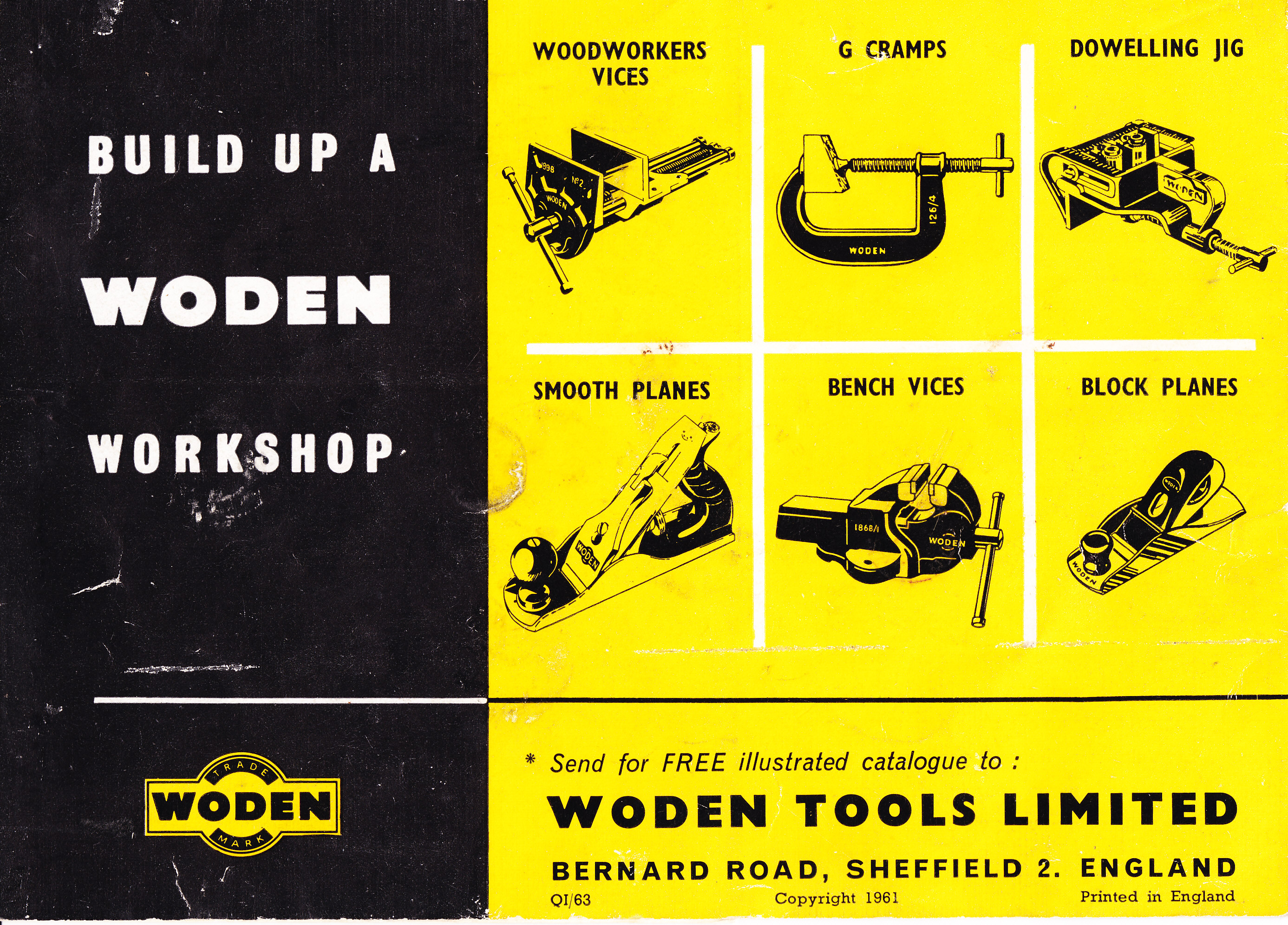 Above, back of tool instructions c.1963 Left, extract from "Building up a Woden Workshop" publication 600/2 c.1962  Predominant colours found in catalogues and tool instructions from 1962 |