Steel Nut Bench Planes 1954 to 1961
|
Original WW bench planes are those manufactured in “The Woden” factory of the Steel Nut & Joseph Hampton Ltd., Wednesbury Staffordshire, between 1954 and early 1961. The full range of Woden bench planes were introduced in catalogue 52e of 1954. See Woden plane line up in the History Page and catalogue IMG's 0001 and 0002.
sizes W4 and W5, in ‘The Woodworker’ magazine issues of 1954/55. All the planes were manufactured to the Stanley Bailey pattern. Sizes W4 and W5 shared the same 2 inch cutter, frog, lever cap and cutter adjustment mechanisms. W5 body castings were larger, as were the knobs. The W5 handle also incorporated a brass toe screw and cup washer. Sizes W4-1/2, W5-1/2, W6 and W7 had larger cutters (2-3/8 inches), a common frog size for the cutter and also more substantial body castings. Similarly priced to Record and Stanley, these planes were based on the earlier bench plane range from W.S Manufacturing which SNJH acquired around 1952. They were substantially made and accurately machined. “These planes are made to the highest standards of British Engineering”. IMG 0003 Woden  IMG 0004 Woden W5 as advertised in 1955 | ||||||||||||||||||||||||||||||||||||||||||||||||||||||||||||||||||||||||||||||||
Names
for bench plane parts:The following table lists the Woden parts for bench planes which are copies of Stanley originals. The names originate from Woden catalogues, spare parts list (S.P.L.) or Woden plane instruction leaflets. The part numbers are those given in Stanley catalogues of the same vintage. Other makers, for example Record, also used these part numbers. The Stanley names and those used by other makers and/or common names are also given. See table 001
Table 001 bench plane parts | ||||||||||||||||||||||||||||||||||||||||||||||||||||||||||||||||||||||||||||||||
Comparison
with earlier WS planes:After taking over W.S in 1952, SNJH took time to set up a production line for bench planes, a new product for the company. According to the catalogues, all parts were made in The Woden factory which included a foundry, steel & screw works and laboratory. It is evident that its planes were derived from W.S, retaining some earlier features and changing the materials and finish of others. W.S bodies had rounded side tops. The Woden body shape (W4) was similar to late W.S examples with a more gradual rounding down to the toe and a slope to the heel. See IMG's 0005 and 0006.  IMG 0005 Woden W4 side elevation for comparison  IMG 0006 W.S A4 The Woden bodies were more uniform than W.S with no grinding marks and ground square top edges. These edges and the toe were unpainted. W.S paintwork was lighter in shade with a hint of purple. Woden paintwork was darker. W.S planes had the earlier pre-war Stanley type frog receiver with unbroken transverse surfaces for the frog. The frog receiver on Woden planes was the later Stanley type with split bearing surfaces for the underneath of the frog. W.S had the pre-war style Stanley parallel sided, continuous surface bed type frog, similar to Record. Woden had an ‘Ogee’ side shaped frog from first introduction. Substantial round headed frog screws seen on late W.S examples were used by Woden for all sizes. The W.S brass lever cap and knurled headed lever cap screw were replaced with parts in chromium plated steel. Very early Woden planes had cutters with sharp angles to the top corners, as per W.S and early to mid-1950's examples by Record, Stanley and other manufacturers. W.S and others used a stamping method to mark their cutters (see IMG 0007), but Woden used a shallow surface printing process. See IMG 0014.  W.S
and Woden cap irons were similar with the same top edge profile. W.S
and Woden cap irons were similar with the same top edge profile.W.S included its intertwined brand mark on the cutter face, together with cutter grinding angle instructions on the top of the cap iron. Woden cap irons were not marked. All Woden cutter depth adjustment wheels were made of brass and marked “ON OFF CUT” with directional arrows. W.S adjustment wheels were not marked. W.S planes had the “Y”adjusting lever as a 2-piece pressed steel part, sometimes ebonised. Woden planes had a single piece, cast and painted part. The more substantial pressed steel lateral lever seen on later W.S was used by Woden for all sizes. However, the Woden part was chromium plated with a circular disc, rather than a rectangular profile to engage the double iron. W.S wood parts were mostly beech, finished in a clear or natural lacquer. Woden handles are flat sided, similar to W.S, but finished in dark stained lacquer with a more glossy finish. Woden retained the brass toe screw and washer of the larger W.S planes, fitted to the handles of all planes, apart from W4. IMG 0007, showing W.S markings on cutter and cap iron. The small parts fitted to W.S planes, lateral levers, screws, etc., varied over time and either had no protective finish, or were ebonised. Original Woden parts were consistent throughout the manufacturing period, with a protective finish. | ||||||||||||||||||||||||||||||||||||||||||||||||||||||||||||||||||||||||||||||||
Woden sizes in detail:Size No. W4:example c.1954.  IMG 0008 (above), an early Woden W4  IMG 0009 (right), showing the plane partly dismantled frog, but this has been shown for clarity. Should you wish to thoroughly clean, repair or restore the plane, it can be dismantled into 24 individual parts. Body:enamel”. The paint colour was very similar to Record (roundel blue). Length 9-3/4 inches (245mm), width 2-7/16 inches (61 mm), weight 3-3/4 pounds (about 1.8Kg). The sole thickness is nominally 5/32 inches (4 mm) and the sides 1/8 inch (3.2 mm), but this did vary slightly with finish grinding of different batches of parts. On this example, at the rear of the mouth where the cutter is supported, the thickness reduces to about 3/32 inches (2.5 mm), the same as the sides.  IMG 0010 W4 body showing side thichkness and cast marks IMG 0010 shows the Woden brand identification cast into the body, the seating for the knob and handle, and the frog receiver.  IMG 0011 shows the frog receiver in detail. Note the end milling on the bearing surfaces for the underneath of the frog. Frog:number mark on the right hand side. See IMG's 0012 and 0013. This type of frog was designed to reduce friction between the cutter and its bed on the frog, whilst retaining maximum cutter support . Woden was one of the first British manufacturers to introduce it in 1954. Some cutter beds have a single lower inset pane across the lower width. Others have two panes. The underneath mating surfaces were well machined with a slight overspill of paint on some examples. IMG 0011 W4 frog receiver detail After assembly, some mid production frogs were coated with a clear protective lacquer.
Lever Cap and Screw:sides are smooth; the reverse is rough but plated. The spring steel plate to secure the lever cap on the cap iron (operated by the lever cam), is smooth chromium plated steel. The ‘WODEN’ brand name was cast into the face below the orifice and was surrounded by a painted red background. Some very early lever caps have an indistinct 9/32 inch (7 mm.) flat across the lower inside edge. (see Dating Page).
The lever cap screw has a 24 tpi 9/32 inch USA UNF thread, in common with other vintage planes, and is chromium plated steel. The screw has a distinct chamfer and “waist” underneath the screw head. The orifice for the screw is about 21 x 12 mm. This ensures that the lever cap cannot be tightened in an incorrect position after replacing the cutter, as it cannot slide down to be locked by the cam unless the screw is approximately in the correct postion. See IMG 0016.
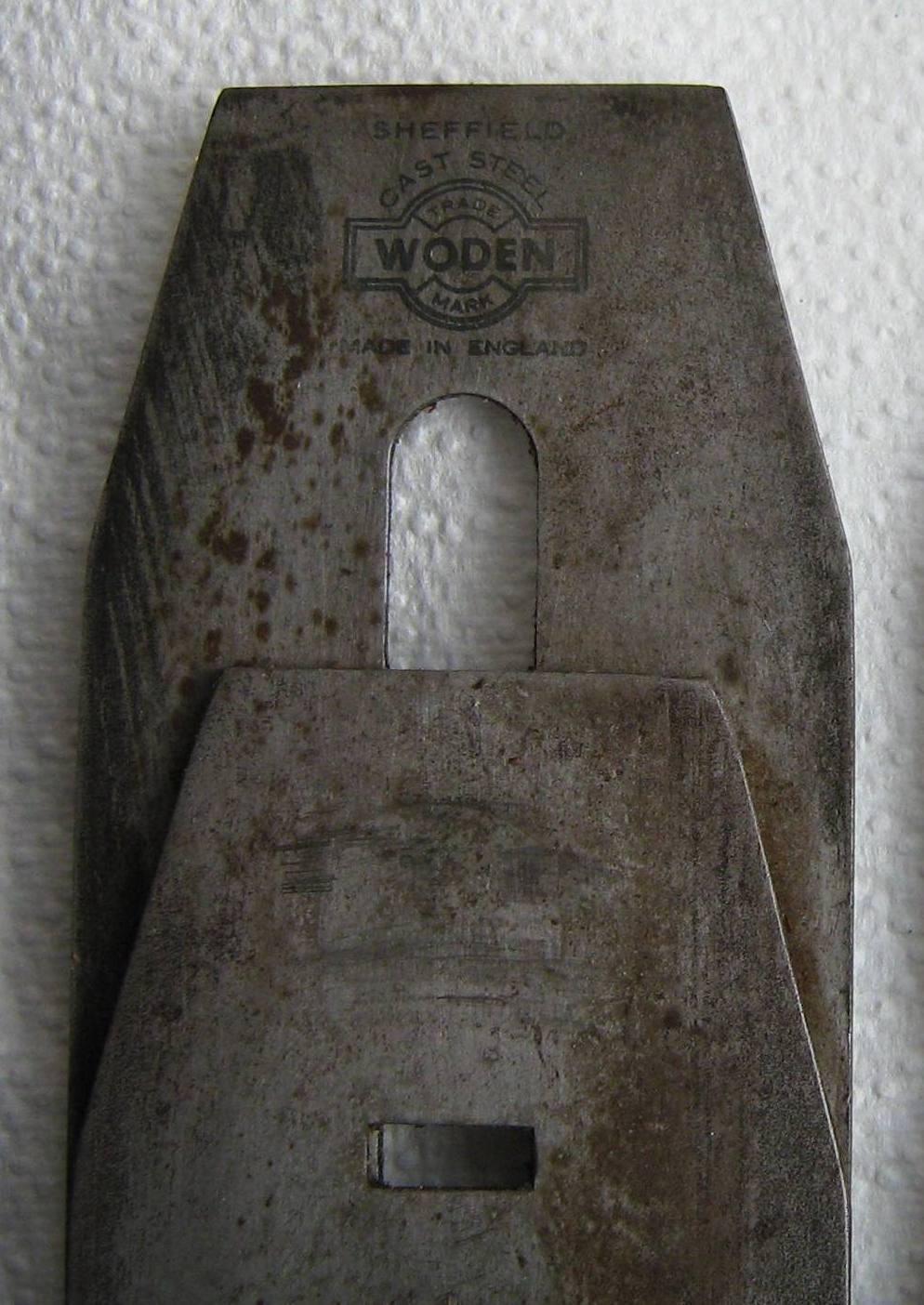
Cutter and cap iron:individually tested for the correct hardness”. The cutter would have been shaped, ground, hardened and tempered at the factory, before final testing and marking. See IMG 0014. On 2 inch cutters, the measurement from ground edge to adjustment slot was approximately 1-7/8 inches, giving a maximum of about 1-1/2 inches of usable cutter.
The cutter and cap iron share the same top edge profile with sharp corners. Unlike other makers, the Woden cap iron shows no identity marks. The cap iron has a distinct round shape at the cutter face end which serves to exert good pressure on the back of the cutter. See IMG 0018. The cap iron remained the same throughout production but the cutter top profile and finish did vary. The cap iron screw was always a knurled and blued steel finished slotted screw, 18 tpi. 5/16 BSW thread. See IMG 0017. Cutter
adjustment and small parts:threaded adjustment screw. The adjustment wheel is marked "ON OFF CUT" with directional arrows. See IMG 0019. The “Y” lever is a painted wishbone shaped casting. finger end. The lever is riveted into the top of the frog. Unlike other planes, the rivet is countersunk into the back of the frog and finished flush. See IMG 0021. The Frog adjuster screw, frog clip and screw are chromium plated steel. The screws are cheese headed and bevelled. The frog clip is angled backwards to make a right angled connection with the slot in the frog adjuster screw. See IMG 0020. Frog screws were always substantial round headed screws “treated with an anti-rust process”.
With the exception of the lever cap screw and cap iron screw which had threads in common with other manufacturers, all other Woden screw threads were 26 tpi, ¼ inch BSF. Wood
parts and fittings:dark mahogany, maturing to chestnut brown. They are well contoured with flat sides. The handle is screwed into the body and there is a locating stud on the body which fits into the base of the handle. The knob is also well contoured and the base fits into a boss on the plane body. The steel rods which secure the handle and knob have brass nuts with straight sides and a mushroomed top for the screwdriver slot. See IMG 0022. The WODEN brand transfer slide sticker was always affixed to the top rear handle surface. See IMG 0023.
| ||||||||||||||||||||||||||||||||||||||||||||||||||||||||||||||||||||||||||||||||
Size No. W5:IMG 0024 shows a late example with a new improved cutter (NIC).  IMG 0024 A late example W5 with NIC. and heel which are 7/32 inch (5.5mm) wide. It has a raised platform at the rear to accept the handle. The platform has two screw sockets, one for a toe screw and the same pillar as W4 for the handle stud. There is also a strengthening rib from the front of the handle platform to the back of the frog. See
The handle is the same height as W4 but it has a more curved profile at the front, flattening out to accept the washer and screw. The knob is also slightly larger than W4, at 70mm in height and a maximum 40 mm in diameter. See IMG 0026. | ||||||||||||||||||||||||||||||||||||||||||||||||||||||||||||||||||||||||||||||||
Size No W4-1/2: The larger or “heavy” smoothing plane.W4-1/2 is the smallest plane with a 2-3/8 inch (60 mm.) cutter.  IMG 0027 The body sides are thicker than W4 but similar to W5 with the same handle platform details. The handle and
knob are the same as W5.An early W4-1/2 complete with instructions and packaging. The frog is wider to accept the larger cutter and has a two vertical lower pane arrangement instead of a single lower pane. There is also a break in the bearing surfaces above the lever cap screw. See IMG 0028. The lever cap is also wider and all 2-3/8 inch lever caps had an indistinct 9/32 inch (7 mm.) flat across the inside lower edge. See IMG 0029 and the Dating Page for more information. All other parts are the same as W4/W5.
| ||||||||||||||||||||||||||||||||||||||||||||||||||||||||||||||||||||||||||||||||
Size
No. W5-1/2:W5-1/2 has identical parts to W4-1/2 apart from the body casting. (2.7 Kg.). It has substantially thick sides at around 3.5 mm to 4 mm. (9/32 inches or 7 mm.) than all the other sizes. All other parts are the same as W4-1/2.
 IMG 0032 The Woden W7 Corrugated
base or “C” sizes:All SNJH Woden bench planes were available with corrugated bases. As far as is known, the body castings did not include the suffix “C” as indicated in the catalogues and price lists, so it is assumed that the corrugations were machined into the soles of standard sizes as ordered. These planes are extremely rare. Performance:IMG 0033 shows the Woden Plane Instructions for bench planes. IMG 0033 Extract from Woden Plane Instructions  Woden
planes easily accomplish the design objectives of all sizes in Woden
planes easily accomplish the design objectives of all sizes inall types of timber. With the cutter prepared as per the Woden instructions, a shaving thickness of about 2 to 3 thousands of an inch may be obtained. This equates to the typical error in the flatness of the sole and is an excellent result for a 1950’s vintage tool. If you wish, and depending on the timber and type of planing operation to be performed, performance may be improved by flattening the sole, tuning up the frog-cutter mating surfaces and closing up the mouth with the fine frog adjustment. A thicker cutter also improves performance and the new improved cutter (NIC) found in later examples performs really well, especially if both edge surfaces are given a ‘mirror’ finish. There are some negatives, as in all tools in volume production. early examples with a rough finish to the sides with coarse radial grinding marks, where finish grinding has not been carried out. On most examples, the top of the lateral lever is only a friction fit to the rivet at the top of the frog. This is not a problem when the tool is in use but such levers may fall off when the cutter is removed for sharpening. Over time, some users have attempted to cure this problem by peening or mushrooming the top of the rivet. There can be some lost motion in the lateral adjustment on some examples, as the circular end of the adjustment lever may be quite narrow in relation to the width of the slot in the cutter. As with all Bailey pattern planes, after adjusting the cutter to reduce depth of cut, take care to advance the adjusting wheel clockwise to take up any slack in the mechanism. Planes made from the mid 1950’s have a smooth and lacquered finish to both sides of the cutter and cap iron. This has the advantage of protecting the metal, but makes it tricky to mate the two components together after sharpening as the cap iron can slip too near the cutting edge as the cap iron screw is tightened. As with most vintage grey iron castings, the body is quite brittle so If the plane is dropped, it may break or fracture, typically around the area of the mouth or side cheeks. Take care to handle and use the plane with two hands to avoid damage by fracturing the handle at its weak point, the "short grain" at its base. This is particularly important with the larger, heavier sizes. IMG 0034 A late Woden planes advert from The Woodworker, 1960/61 There are some examples with an unusual finish such as the rounding to the bottom corners of lever caps from around mid 1954. This aids the clearance of shavings from the mouth but, unfortunately, was not retained. It could have prevented ‘chipping’ to the brittle corners of the part. Buying a Woden Bench Plane:The best Woden planes to buy as 'Users' are from the mid production period (1955/57) as described in the Dating Page.This is confirmed by the number of consistent quality examples from this period with Woden factory parts. Around mid 1957, the New Improved Cutter (NIC) was introduced in the 2-inch size for W4 and W5. A mid production plane with this cutter is the very best example. To date, no 2-3/8 inch NIC's have been identified. If you want one of the larger sizes, a more substantial carbon steel or A2 cutter can be fitted. |